When the International Building Code (IBC) mandates a geotechnical investigation in Tacoma, it is responding to a subsurface reality shaped by the Vashon glaciation. The city sits on a complex sequence of recessional outwash, glacial till, and the sensitive Commencement Bay lacustrine deposits, all of which require rigorous characterization before a single footing is poured. Our soil mechanics study goes beyond standard borings by applying ASTM D1586 procedures within a framework calibrated to the South Sound’s stratigraphic variability—where a 15,000-year-old advance outwash deposit can lie directly beneath a loose urban fill, creating a bearing condition that no prescriptive foundation table can address. For projects near the Tacoma Dome or the Foss Waterway, where soft estuarine clays extend to significant depths, the CPT test provides a continuous profile that complements the discrete sampling of conventional drilling, and our laboratory program—including triaxial shear on undisturbed specimens—generates the strength parameters that drive a defensible footing design.
A Tacoma site characterized by glacial outwash over Lawton Clay demands more than a bearing capacity check—it requires a seepage and settlement model calibrated to forty inches of annual rainfall.
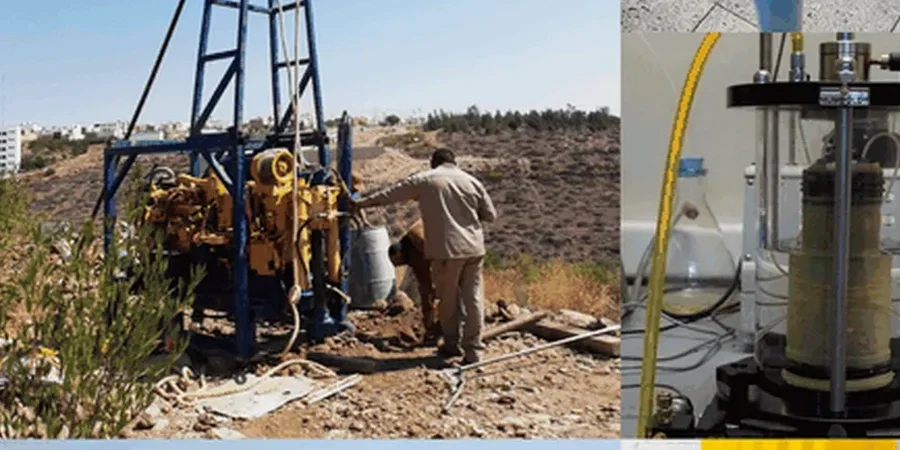
Service characteristics in Tacoma
Critical ground factors in Tacoma
The split-spoon sampler driven by a 140-pound hammer falling 30 inches is the heartbeat of a Tacoma subsurface investigation, but the real diagnostic power lies in what happens to those samples after they leave the rig. Our laboratory consolidates the Shelby tubes, extruding the thin-walled samples under controlled conditions to preserve the fabric of the sensitive silts that characterize the Commencement Bay lowlands. When a contractor skips a soil mechanics study and relies on a simple hand-auger profile, the consequence is not theoretical: we have reviewed sites near the Port of Tacoma where undocumented peat lenses, compressed under embankment loads, produced differential settlements exceeding four inches within the first year of service. The IBC requires a geotechnical report that addresses slope stability for any cut or fill exceeding five feet in height, a threshold that triggers automatically on the hillside lots overlooking Commencement Bay. A properly executed study integrates the laboratory-derived effective stress parameters into a limit equilibrium analysis that quantifies the factor of safety against a rotational failure through the weathered till.
Our services
A Tacoma project benefits from a soil mechanics study structured around the specific geohazards of the South Sound. The three service tiers below represent progressively deeper levels of investigation, from a code-minimum program suitable for a single-family residence on a flat till site to a comprehensive package for a multi-story structure near the shoreline.
Foundation Design Soil Mechanics Package
Targeted investigation for shallow foundation support on Tacoma’s glacial soils. Includes SPT borings with laboratory classification, Atterberg limits, and consolidation testing on cohesive layers, delivering a complete bearing capacity and settlement analysis calibrated to the site-specific stratigraphy encountered.
Seismic Site Response and Liquefaction Evaluation
Applies ASCE 7-22 Chapter 20 site classification procedures to the loose alluvial sands of the Puyallup Valley and the Nisqually River corridor. Incorporates cyclic triaxial or cyclic direct simple shear testing on critical samples, with a Seed-Idriss simplified procedure analysis for liquefaction triggering and post-liquefaction settlement prediction.
Slope Stability and Deep Excavation Analysis
For hillside developments and projects with basement excavations exceeding 10 feet in depth. Combines effective-stress shear strength parameters from triaxial testing with limit-equilibrium modeling (Spencer’s method) to evaluate global stability, and provides lateral earth pressure diagrams for shoring design in Tacoma’s interlayered glacial deposits.
Quick answers
What is the typical cost range for a soil mechanics study for a commercial building site in Tacoma?
For a typical commercial site in Tacoma requiring two to four borings with laboratory testing and a full geotechnical report, the soil mechanics study generally ranges from US$2,930 to US$5,840. The final cost depends on the depth of the borings (deeper sites near the Foss Waterway require more linear footage), the number of Shelby tube samples for consolidation and triaxial testing, and whether a seismic site class determination with shear wave velocity measurements is included in the scope.
How deep do borings need to go for a soil mechanics study in Tacoma's glacial till?
Boring depth in Tacoma follows IBC Section 1803.5.5, which requires borings to extend through all unsuitable bearing strata and into competent material. In practice, for a site on the Vashon till plateau, borings typically extend 15 to 25 feet below the proposed footing elevation to confirm that the dense till is continuous and not underlain by a softer advance outwash unit. For sites near the Puyallup River, where Holocene alluvium can reach 60 feet or more, borings frequently extend to 50 to 70 feet to evaluate both bearing and liquefaction potential.
What laboratory tests does a soil mechanics study include for a Tacoma hillside lot?
A hillside lot investigation on Tacoma’s slopes—such as those above Ruston Way or in the North End overlooking Commencement Bay—includes consolidated-undrained triaxial shear tests with pore pressure measurement to determine effective stress parameters (c’ and φ’) for the weathered till and the underlying Lawton Clay. We also run Atterberg limits and natural moisture content profiles to identify zones of high plasticity that could control the failure surface geometry in a slope stability analysis.
How long does a soil mechanics study take from field investigation to final report in Tacoma?
The field investigation—drilling, sampling, and in-situ testing—is typically completed in two to four days for a standard commercial site. Laboratory testing requires an additional three to four weeks, primarily due to the consolidation testing schedule (incremental loading over 24 to 48 hours per specimen). The final geotechnical report, including engineering analyses and foundation recommendations, is delivered approximately four to five weeks after the completion of field work.
Does Tacoma's seismic setting affect the scope of a soil mechanics study?
Absolutely. Tacoma sits in a region influenced by the Cascadia Subduction Zone (magnitude 9.0 capable) and the shallow crustal faults of the Puget Lowland, including the Tacoma Fault that runs directly beneath the city. ASCE 7-22 requires a site-specific seismic site class determination. For structures assigned to Seismic Design Category D or higher, our soil mechanics study extends to a liquefaction triggering evaluation using the Seed-Idriss simplified procedure, with post-liquefaction settlement calculated from the Ishihara and Yoshimine (1992) methodology calibrated to the standard penetration resistance of the granular layers encountered.