ASTM D4767 and D2850 define the standard for triaxial compression testing, but the results are only as good as the sample handling and local geological interpretation. In Tacoma, the subsurface is a complex mix of Vashon glacial drift, advance outwash, and volcanic lahar deposits from Mount Rainier. These materials behave differently under load depending on moisture content and confining pressure. A consolidated-undrained test with pore pressure measurement reveals how the silty sands found near the tide flats will respond during rapid loading. The Port of Tacoma area, with its hydraulic fill and soft estuarine clays, demands careful effective stress analysis. Our team runs triaxial tests on undisturbed Shelby tube samples and remolded specimens to generate the friction angle and cohesion values engineers need for foundation design and slope stability analysis in this geologically active region.
The friction angle is not a fixed number; it's a function of density, stress history, and drainage conditions unique to each Tacoma site.
Service characteristics in Tacoma
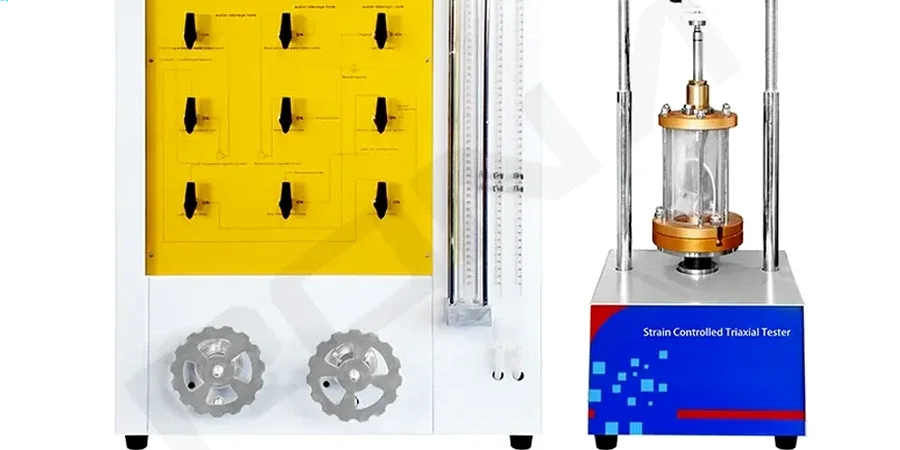
Critical ground factors in Tacoma
A six-story mixed-use building near South Tacoma Way ran into a problem during schematic design. The geotechnical report used published friction angles from the USDA soil survey, which significantly overestimated the shear strength of the local glacial lacustrine silts. The original spread footing design was too narrow. After we ran a series of isotropically consolidated undrained triaxial tests on high-quality thin-walled tube samples, the measured effective friction angle came in three degrees lower than the assumed value. The structural engineer had to increase footing widths by 25 percent and add grade beams to bridge softer pockets. The cost of the triaxial testing was negligible compared to the retrofit that would have been required if differential settlement appeared after construction. Tacoma's layered stratigraphy rarely matches textbook parameters; site-specific triaxial data is the only reliable path to a safe foundation.
Our services
We supply triaxial testing programs scaled to the specific geological units found in Pierce County. Each test package includes detailed sample preparation and engineering interpretation beyond the raw stress-strain data.
Consolidated-Undrained Triaxial Testing
CU tests on cohesive soils with pore pressure measurement. We apply back pressure to ensure full saturation, then shear the specimen at a controlled strain rate. The output delivers effective stress parameters (c' and φ') that control slope stability and foundation bearing capacity in Tacoma's glacial lake sediments.
Unconsolidated-Undrained Triaxial Testing
Quick UU tests for short-term loading conditions. Suitable for clays and silts where rapid construction generates excess pore pressure. We use this test to confirm undrained shear strength (Su) for temporary shoring and deep excavations in the downtown Tacoma area.
Quick answers
What is the cost of a triaxial test in Tacoma?
A single triaxial test with sample preparation, saturation, and engineering interpretation typically ranges from US$2,050 to US$2,480, depending on whether the test is unconsolidated-undrained or consolidated-undrained with pore pressure measurement. A full testing program with three confining pressures to define the Mohr-Coulomb envelope is the standard approach and would be quoted as a package.
How long does a triaxial test take to complete?
A consolidated-undrained triaxial test on a silty clay from the Tacoma area, including saturation, consolidation, and shear phases, typically requires 5 to 7 working days. Unconsolidated-undrained tests are faster, often completed in 2 to 3 days. The timeline depends on the soil permeability, which controls the consolidation stage duration.
What type of soil sample is required for a triaxial test?
Undisturbed samples obtained with a Shelby tube or thin-walled piston sampler are essential for meaningful triaxial results on cohesive soils. Disturbed samples or bag samples can only be used for remolded testing, which does not represent the in-situ structure. For the Tacoma glacial drift, we coordinate sampling with local drillers to minimize disturbance during transport.
Which triaxial test method is appropriate for my Tacoma project?
It depends on the loading scenario and drainage conditions. For saturated clays under rapid loading, a CU test with pore pressure measurement provides effective stress parameters. For free-draining sands and gravels common on the Tacoma uplands, a drained test (CID) is more appropriate. We review your project's load path and stratigraphy before recommending the specific ASTM method.