The drill rig sets up on a sloped site overlooking Commencement Bay, its diamond core barrel spinning through Tacoma’s characteristic advance glacial till. This is where the work starts—not on screen, but inside the borehole. Soft ground tunneling in this city means confronting the Puyallup Formation: layers of silty sand, compressible clay, and scattered gravel lenses that shift behavior within a few vertical feet. With groundwater perched just meters below street level, every sample logged in the field feeds directly into the finite element model. The team deploys the CPT test to capture continuous stratigraphic profiles in the saturated deltaic deposits, then correlates those readings with triaxial testing to define undrained shear strength parameters for staged excavation sequencing.
Tunneling through Tacoma’s Puyallup Formation demands continuous face pressure tuning—stand-up time in these silts rarely exceeds 45 minutes without support.
Service characteristics in Tacoma
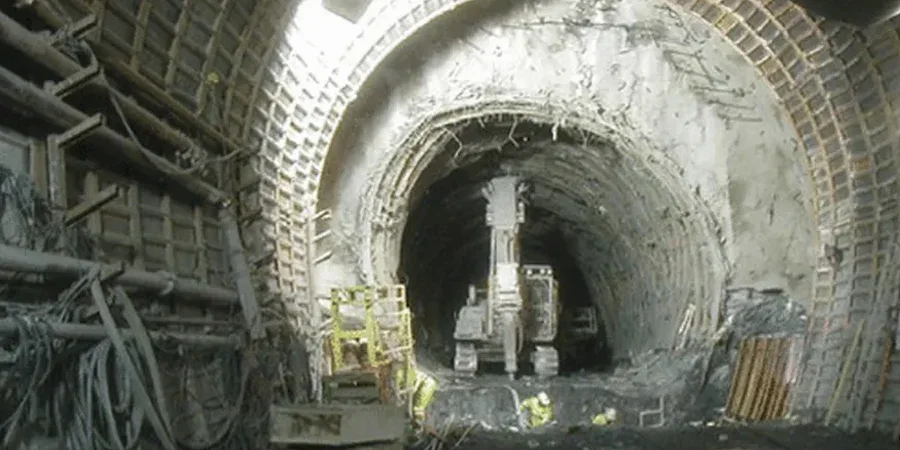
Critical ground factors in Tacoma
Tacoma’s downtown core expanded rapidly after the Northern Pacific Railroad terminus was established in the 1870s, much of it built on sawdust fill and dredged material from the Thea Foss Waterway. These artificial deposits, some reaching depths of 25 feet, were never engineered for modern tunneling loads. A TBM passing beneath them can trigger differential settlement that propagates upward through the fill matrix like a chimney collapse. When the fill contains buried timber pilings or creosote-soaked debris, the risk compounds: decay creates voids, and those voids collapse under vibration. The geotechnical analysis has to distinguish between natural soft clay and anthropogenic fill, because their compressibility curves differ by a factor of three. Missing that distinction turns a routine drive into a surface settlement claim.
Our services
We support soft ground tunneling projects with a focused set of investigation and testing solutions tailored to Tacoma’s geology:
Geotechnical Baseline Report preparation
Compile site-specific stratigraphy, groundwater data, and design parameters into a defensible GBR aligned with ASCE guidelines—critical for managing differing site condition claims during TBM drives.
Laboratory stress path testing
Advanced triaxial and oedometer programs that replicate the unloading-reloading sequence a tunnel face imposes, giving you realistic modulus values for settlement prediction.
Instrumentation and monitoring plans
Design arrays of in-place inclinometers, settlement points, and piezometers above the alignment to track ground response in real time and trigger contingency protocols.
Face stability assessments
Analytical and numerical evaluations of blowout and collapse risk under pressurized face conditions, factoring in Tacoma’s perched aquifers and tidal influence on pore pressures.
Quick answers
What distinguishes Tacoma’s soft ground from Seattle’s for tunneling?
Tacoma sits on the Puyallup Formation—a sequence of glacial advance outwash, recessional lacustrine silts, and volcanic lahar deposits from Mount Rainier. Seattle’s soft ground is predominantly glacially overconsolidated till and Vashon recessional deposits. Tacoma’s material is less overconsolidated and contains more volcanic fines, which behave thixotropically: they lose strength when sheared and regain it slowly during standstill. That property directly affects TBM restart procedures and annular grout timing.
How does tidal fluctuation affect tunnel face stability near the Thea Foss Waterway?
Tidal range in Commencement Bay averages 12 feet, and the hydraulic connection between the waterway and the shallow aquifer means pore pressures at tunnel depth can swing by 3 to 5 psi over a six-hour cycle. During ebb tide, the reduced confining pressure at the face can drop the factor of safety below 1.2 in silty zones. We instrument the alignment with vibrating wire piezometers and correlate readings with tide tables to advise the contractor on face pressure adjustments in real time.
What is the typical cost range for a soft soil tunnel geotechnical analysis in Tacoma?
A complete analysis—covering field investigation, laboratory testing, and analytical reporting—runs between US$4,330 and US$14,410 depending on borehole count, depth, and the number of advanced triaxial tests needed. Projects requiring instrumentation monitoring plans fall toward the upper end of that range.