In Tacoma, we often see subgrade surprises once the wet season hits. The city sits on a complex mix of Vashon glacial till, recessional outwash, and pockets of urban fill near the port. You can hit hardpan on one end of the lot and saturated silt on the other. That variability directly impacts pavement performance. We run the laboratory CBR test under controlled moisture conditions to remove that guesswork. A soaked CBR value tells you how the soil will actually behave after a Tacoma winter, not just how it looked on a dry August afternoon. We pair this with field density checks when clients need to validate compaction, and we often recommend a sand cone density survey beforehand so the lab sample correlates with the in-place condition. For deeper fill profiles near the Puyallup River delta, a CPT test can map the layering before we select the right remolded sample depth.
A soaked CBR value is not a generic number. It is a direct measurement of how your Tacoma subgrade will survive the rainy season under traffic loads.
Service characteristics in Tacoma
Working video
Critical ground factors in Tacoma
ASTM D1883 and the AASHTO Guide for Design of Pavement Structures are the governing documents for CBR testing in Washington State. In Tacoma, the risk of ignoring a soaked CBR is concentrated in the wet months between November and March. We have seen pavement sections fail in less than two years because the design assumed a CBR of 6% based on a dry sample, while the soaked value was closer to 1.5%. The subgrade lost bearing capacity under saturation, the base course rutted, and the asphalt cracked in alligator patterns. This is especially common in the tide-influenced fill areas near the Thea Foss Waterway. A soaked CBR test costs a fraction of a pavement reconstruction. It also satisfies the geotechnical reporting requirements that Pierce County and City of Tacoma planners expect in permit submittals for commercial site development.
Our services
Our Tacoma geotechnical lab handles CBR testing as part of a broader pavement evaluation workflow. We work with civil contractors, geotechnical consultants, and site developers across Pierce County. Each project starts with a clear definition of the design traffic and the subgrade material type.
Soaked CBR (ASTM D1883)
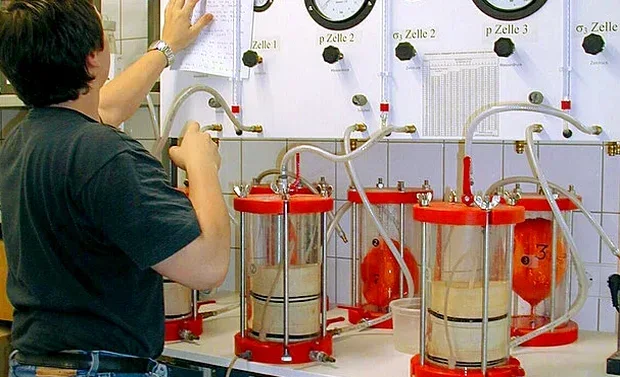
We remold the sample at target moisture, apply a 10-lb surcharge, and soak it for 96 hours. We report CBR values at 0.1 and 0.2 inches of penetration, plus the swell percentage, so the pavement designer has the full picture.
Subgrade Characterization Package
We combine the CBR test with Atterberg limits and a Proctor compaction curve from the same bulk sample. This gives the contractor the target moisture range for field compaction and the expected bearing strength in one report.
Pavement Thickness Verification
Using the lab CBR result and the AASHTO empirical equation, we calculate the required structural number and supply aggregate base and asphalt thickness recommendations per WSDOT standard specifications.
Quick answers
What is the typical turnaround time for a laboratory CBR test in Tacoma?
We schedule a standard turnaround of 5 to 7 business days from sample delivery to the final report. If the project needs an expedited result, we can run the compaction and CBR in parallel and deliver within 3 business days. The 96-hour soaking period is fixed by ASTM D1883, so that part cannot be shortened.
How much does a laboratory CBR test cost?
The cost for a single-point soaked CBR test in our Tacoma lab, including the Proctor compaction curve, ranges from US$120 to US$210. The final price depends on whether we are running a standard Proctor or a modified Proctor, and whether the sample requires additional preparation due to oversize particles.
Can you test aggregate base course with the CBR method?
Yes. ASTM D1883 applies to both fine-grained subgrade soils and coarse-grained base materials, as long as the maximum particle size does not exceed 3/4 inch. For crushed aggregate base commonly used in Tacoma road construction, we use the modified Proctor compactive effort and a larger surcharge ring if the pavement structure requires it.
Do I need a soaked CBR or just at optimum moisture?
In Tacoma, we almost always recommend the soaked CBR because the water table is high in many areas and seasonal saturation is predictable. An unsoaked value gives a false sense of security. The soaked test simulates the worst-case condition the subgrade will background after a sustained rainy period, which is the condition that governs pavement life.