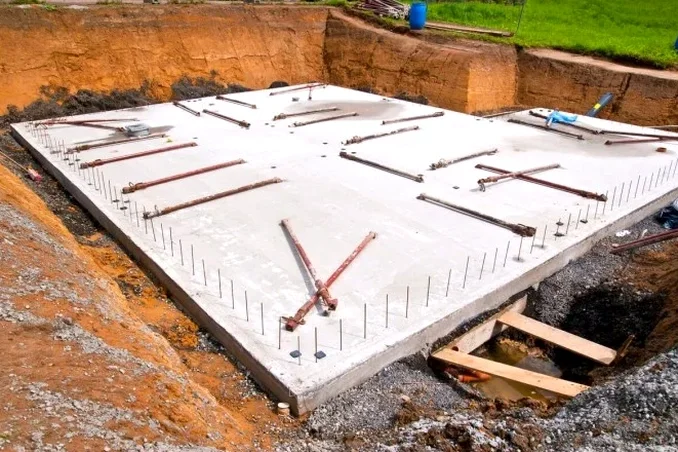
The most expensive mistake a Tacoma builder can make is pouring a standard spread footing on glacial till that looks firm but hides a soft lens of outwash silt. Years of compaction delay and differential settlement claims in the Foss Waterway area trace back to that exact assumption. Raft foundation design solves this by distributing structural loads across a continuous reinforced slab. Instead of fighting variable soil stiffness point by point, the mat bridges weak zones. For sites near the Puyallup River delta where the subsurface alternates between compact gravel and compressible alluvium, this approach saves rework and reduces long-term cracking risk. A CPT test provides the continuous stratigraphic profile needed to model the soil-structure interaction before finalizing the mat reinforcement layout.
A properly designed mat foundation turns Tacoma’s erratic glacial stratigraphy from a liability into a uniform bearing platform.
Service characteristics in Tacoma
Working video
Critical ground factors in Tacoma
Tacoma sits at 47.2455°N latitude with a seismic hazard profile shaped by the Cascadia Subduction Zone, the Tacoma Fault, and the Seattle Fault. The 2001 Nisqually earthquake produced modified Mercalli intensities of VI to VII across the city, and building codes have tightened significantly since then. A mat foundation on liquefiable silts without ground improvement can tilt during cyclic loading, even if static bearing checks pass. The high groundwater table in the Tideflats and along Commencement Bay accelerates this risk. Our design process integrates ASCE 7-22 spectral accelerations with site-specific liquefaction triggering curves. If the factor of safety against buoyancy or seismic bearing loss drops below 1.1, we adjust the mat geometry or recommend densification before construction begins.
Our services
Every mat foundation project in Tacoma starts with a soil investigation calibrated to the site’s glacial history. The deliverables below define the geotechnical baseline for structural design.
Mat Foundation Geotechnical Report
Includes boring logs, CPT soundings, lab consolidation and shear strength data, liquefaction screening, and a complete subgrade reaction modulus profile. Delivered with CAD-ready bearing layer maps and settlement contours.
Construction-Phase QA/QC
Subgrade proof-rolling observation, mud mat inspection, rebar placement review against the approved plans, and concrete pour monitoring. We verify that the exposed bearing surface matches the design assumptions before the first truck arrives.
Quick answers
What does a mat foundation design typically cost for a Tacoma project?
The geotechnical investigation and engineering design package generally runs between US$1,050 and US$3,800. The final fee depends on the number of borings, whether CPT is required, and the complexity of the seismic analysis. A small commercial slab on competent Vashon till costs less than a multi-story mat in the liquefiable Tideflats.
When is a raft foundation better than deep piles in Tacoma?
A mat works best when the bearing stratum is within 10 to 15 feet of the surface and the total settlement can be kept under one inch. If the site has an erratic mix of dense gravel and soft silt, the mat bridges the weak spots without the cost of driving piles to the advance outwash. Piles become the better option when compressible soils extend deeper than 20 feet or when the structural loads exceed what the upper glacial units can carry.
How does the Tacoma Fault affect mat foundation design?
The Tacoma Fault runs roughly east-west through the city and can generate shallow crustal earthquakes with short-period ground motion. Our design accounts for this by applying the site-specific spectral accelerations from ASCE 7-22, checking the mat for both inertial loading and kinematic soil-structure interaction. The reinforcement detailing in the mat corners and shear walls is adjusted to handle the higher demand from near-source shaking.