A logistics center expansion near the Blair Waterway had a problem: the concrete dock slabs kept cracking within two seasons, despite following generic WSDOT thickness tables. The culprit wasn't the concrete mix but the fill underneath—old tideflat deposits with pockets of organic silt that compressed unevenly under heavy container handler traffic. In Tacoma, rigid pavement design has to account for a lot more than just axle loads. The city sits on the Puyallup River floodplain, where the natural stratigraphy alternates between glacial till, loose alluvial sands, and layers of volcanic ash from Mount Rainier. The water table sits high across much of the Tacoma tideflats, which means a PCC slab that works fine in Spokane will fail here if the base preparation ignores drainage or long-term saturation. Our approach starts with the subgrade, not the slab, because in this part of Pierce County, the soil dictates the pavement lifespan. We often pair the structural design with a plate load test directly on the prepared subbase to validate the modulus of subgrade reaction before a single cubic yard of concrete is poured.
On the Tacoma tideflats, the subgrade stiffness dictates the slab life—get the k-value wrong and the best concrete mix won't save the pavement.
Service characteristics in Tacoma
Critical ground factors in Tacoma
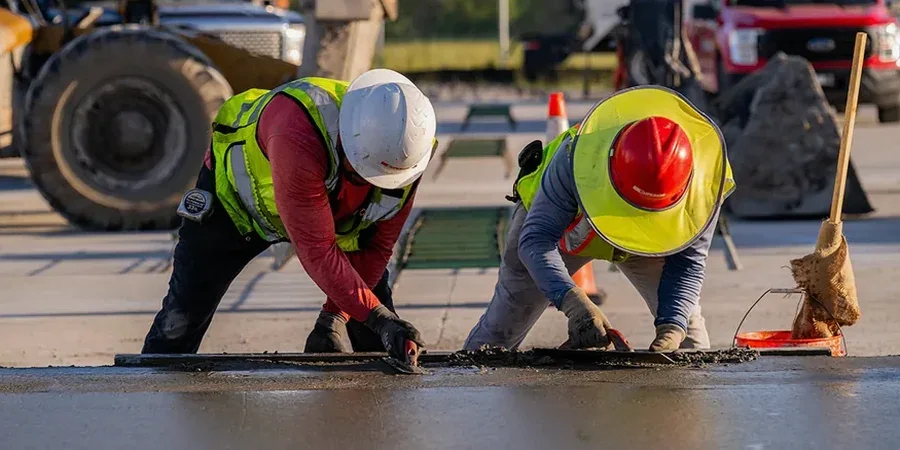
The slipform paver moves steadily across the prepared grade, laying a consistent ribbon of low-slump concrete while dowel baskets are placed ahead of the screed. In Tacoma, one of the biggest risks during rigid pavement construction happens before the paver even arrives: inadequate compaction of the upper subgrade due to wet weather. When the native silty soils near the Puyallup River are worked while too moist, they rut under the weight of dump trucks, and that disturbance translates into variable slab thickness and undoweled cracks within the first two years of service. Another risk we see repeatedly on commercial projects is skipping the plate load verification after base installation—assuming the design k-value is met without field testing leads to under-designed slabs that curl excessively at the edges and eventually fault at the transverse joints. For industrial pavements serving the warehousing district around Port of Tacoma Road, joint spalling from overloaded forklifts crossing unsealed contraction joints is a maintenance headache that proper joint detailing and epoxy sealing could prevent from day one.
Our services
From the heavy container traffic at the Port of Tacoma to the residential streets climbing the hillside toward Stadium District, each rigid pavement project starts with a subgrade investigation that matches the expected loading. These are the core phases of our design and verification process in Pierce County.
Subgrade Reaction Testing
Field determination of the modulus of subgrade reaction using plate load tests on prepared subgrade and base layers, critical for accurate slab thickness design on Tacoma's variable glacial soils.
Thickness Design & Joint Layout
ACPA and PCA-based structural design for jointed plain concrete pavements, with joint spacing, dowel sizing, and tie bar placement tailored to industrial, commercial, or residential traffic categories.
Base and Subbase Evaluation
Laboratory testing of aggregate base materials for gradation, moisture-density relationship, and permeability to ensure adequate drainage under the high rainfall conditions typical of Tacoma.
Construction QA/QC Inspection
On-site monitoring during slipform paving operations including concrete sampling, slump and air content checks, dowel basket alignment verification, and post-pour joint saw-cutting timing assessment.
Quick answers
What's the typical cost range for a rigid pavement design package for a commercial lot in Tacoma?
For a standalone rigid pavement design covering subgrade investigation, thickness calculations, and joint layout for a typical Tacoma commercial lot, the fee ranges from US$1,730 to US$6,730 depending on the pavement area, traffic loading complexity, and the number of soil borings or plate load tests required to characterize the subgrade.
How does Tacoma's rainy climate affect rigid pavement design decisions?
The high precipitation—averaging 39 inches per year over roughly 150 wet days—forces a strong emphasis on subsurface drainage and joint sealing. We adjust the AASHTO drainage coefficient downward and specify permeable base layers with edge drains more frequently than in eastern Washington. Without these measures, water trapped under the slab can pump fines from the subgrade at joints and lead to faulting.
Do you use WSDOT standards even for private projects inside Tacoma city limits?
Yes, WSDOT Standard Specifications and the WSDOT Pavement Guide serve as the baseline for material requirements and construction tolerances on most private commercial and industrial projects in Pierce County. For heavier industrial loading at the Port of Tacoma, we supplement WSDOT criteria with ACPA industrial pavement design methods, because the port's container handling equipment generates edge stresses beyond typical highway design loads.
What is the modulus of subgrade reaction and why does it matter for Tacoma?
The k-value represents how much pressure it takes to deflect the subgrade by a unit of length, and it's the primary input for rigid pavement thickness design. In Tacoma, k-values can vary dramatically across a single site because the glacial geology transitions from dense till to loose alluvium. Designing with a generic k-value from a table—instead of measuring it with a plate load test—often results in slabs that are too thin for the softer areas and crack within a few years.
How long does a rigid pavement design and subgrade investigation take for a typical Tacoma project?
A typical timeline runs three to four weeks from field investigation to final design report. The first week covers subgrade borings and plate load testing on site; the second week is laboratory analysis of soil and aggregate samples; the third and fourth weeks are structural design, joint layout drafting, and submittal of the stamped design package. Larger port-area projects with heavy traffic may require an additional week for detailed joint reinforcement and dowel bar calculations.