Tacoma sits at 47.2455°N, where the Puyallup River delta meets Commencement Bay. Much of the city rests on Holocene alluvium and glacial outwash. These deposits exceed 40 feet in many areas. The 2001 Nisqually earthquake reminded us why ground improvement matters here. Loose sands in the tide flats and industrial zones are prone to settlement. Stone column design offers a reliable solution. We correlate vibro-replacement parameters with SPT drilling data from our local boreholes. The compacted gravel columns densify the surrounding soil. They also drain excess pore pressure during seismic events. Our lab processes grain-size distributions per ASTM D2487 to select the right gravel gradation. This ensures the stone column design performs as intended under Tacoma’s specific stratigraphy.
In Tacoma’s tide flats, stone columns do double duty: they densify loose sand and create drainage paths that reduce liquefaction risk during a Nisqually-type event.
Service characteristics in Tacoma
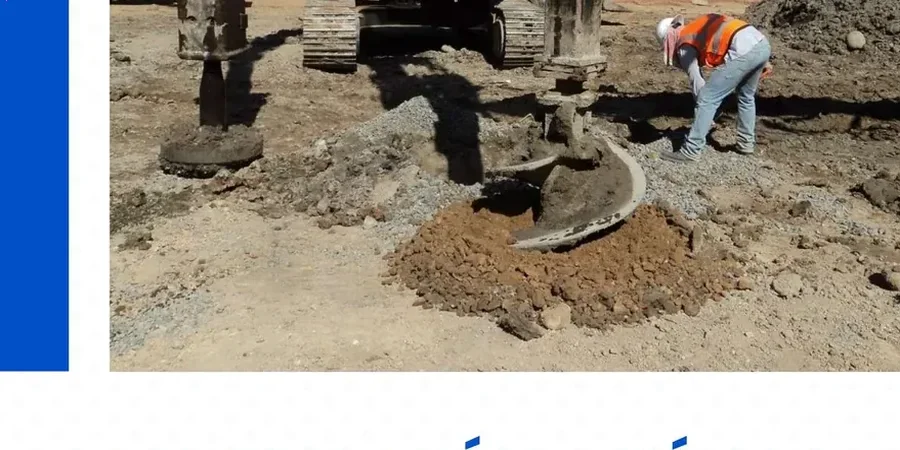
Critical ground factors in Tacoma
IBC Section 1805 requires mitigation of liquefaction hazards for essential facilities in Seismic Design Category D. Tacoma falls squarely in this category. The Nisqually Delta deposits are mapped as liquefaction-susceptible. Skipping stone column design here is not a code option—it is a liability. Soft silts can undergo cyclic softening. Gravel columns prevent this by shortening the drainage path. Without them, excess pore pressure builds up quickly. The ground loses strength. Bearing failures occur. Our design process checks the factor of safety against liquefaction at multiple depths. We use SPT blow counts and fines content to run the analysis. The stone column layout is then adjusted to meet the 1.3 minimum safety threshold. Field verification via post-installation CPT confirms the treatment has achieved the target tip resistance.
Our services
Our ground improvement work in Tacoma focuses on two core areas. Both integrate lab testing with field verification.
Vibro-Replacement Design
We develop stone column layouts for compressible profiles in the port and industrial districts. The design includes gravel spec, spacing, depth, and estimated settlement. We use SPT and CPT inputs from site investigation. Post-treatment verification confirms the achieved densification.
Liquefaction Mitigation Analysis
We run cyclic stress ratio calculations per ASCE 7 for Tacoma’s seismic hazard level. The analysis identifies zones where stone columns are required. We deliver a site-specific report with treatment depth, area ratio, and post-installation testing requirements.
Quick answers
What is the typical stone column design depth in Tacoma’s tide flats?
Most designs target 20 to 40 feet. The depth is driven by the liquefiable layer thickness. Our CPT soundings map the base of the loose zone. We extend columns at least 3 feet into competent material below.
How much does stone column design cost for a Tacoma project?
A design package including lab testing, SPT correlation, and settlement analysis typically ranges from US$1,370 to US$5,870. The final cost depends on the number of borings and the complexity of the soil profile.
Which ASTM standards apply to the gravel used in stone columns?
ASTM D2487 governs the classification of the stone. We specify clean, angular gravel (GP or GW) with a nominal size between 1 and 3 inches. Durability is checked via LA abrasion testing.
Can stone columns eliminate liquefaction risk completely in Tacoma?
Stone columns reduce liquefaction risk significantly by densifying the sand and draining pore pressure. We design to a factor of safety above 1.3. No ground improvement method can offer a zero-risk condition, but vibro-replacement provides a solid mitigation strategy.
Do you verify the stone column performance after installation?
Yes. We run post-treatment CPT soundings between columns. The tip resistance increase confirms the densification effect. We also compare pre- and post-treatment settlement estimates using the measured soil parameters. More info.